

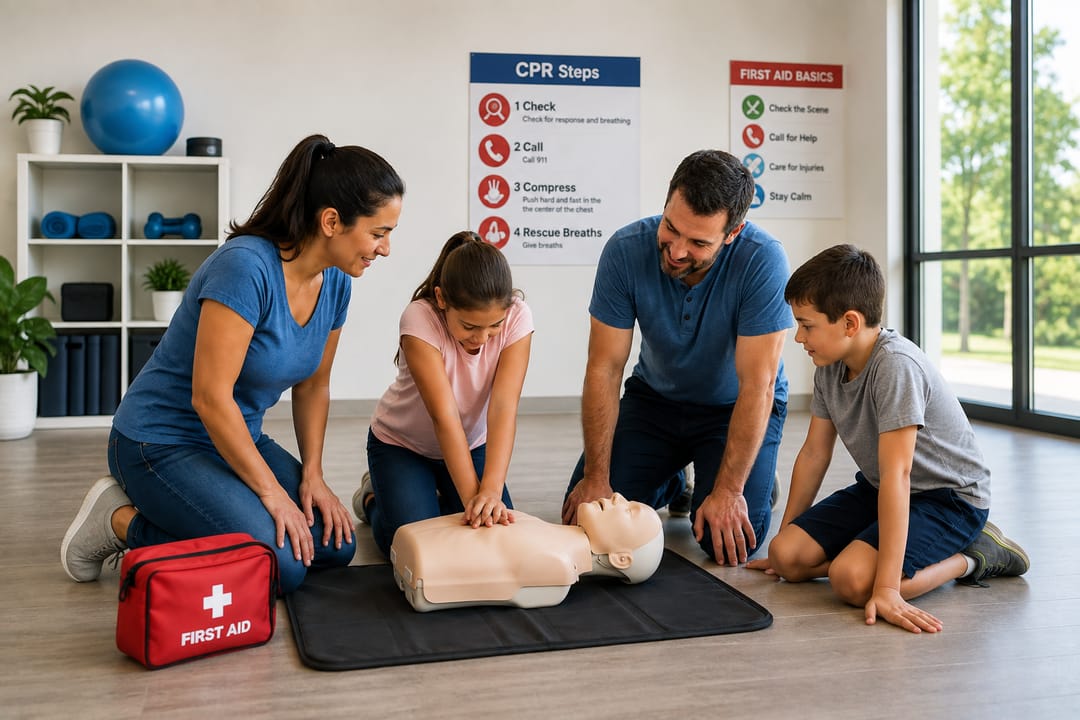
Most out-of-hospital cardiac arrests do not happen in a stadium or airport. About 70% occur at home, yet fewer than 40% of people receive the urgent bystander help they need before professional care arrives. Community CPR and AED training therefore has a surprisingly personal target: the people sitting across the dinner table.
A well-run Community CPR and AED Night should not feel like a lecture with a mannequin in the corner. For organizers building broader community wellness programming, the stronger model is a practical readiness lab where families rehearse who calls for help, who starts compressions, who retrieves the AED, and how those roles change when the patient is a child.
The First Minutes Belong to the People Already There
Cardiac arrest is not the same as a heart attack. The immediate warning pattern is usually sudden collapse, unresponsiveness, and absent normal breathing or gasping. The first response is to activate emergency services, begin CPR, and bring an AED as quickly as possible rather than waiting for a professional to confirm what is happening.
That sequence should shape the event. Participants need to hear a scenario, recognize the emergency, make the call, move to the manikin, and use a training AED under pressure. A polished presentation may improve awareness, but practice must dominate if the goal is action rather than applause.
Build Community CPR and AED Training Around Practice
The central mistake in many public health events is trying to cover too much. CPR, AED use, choking response, first aid, stroke recognition, and emergency planning may all be worthwhile, but crowding them into one fast presentation leaves participants remembering fragments.
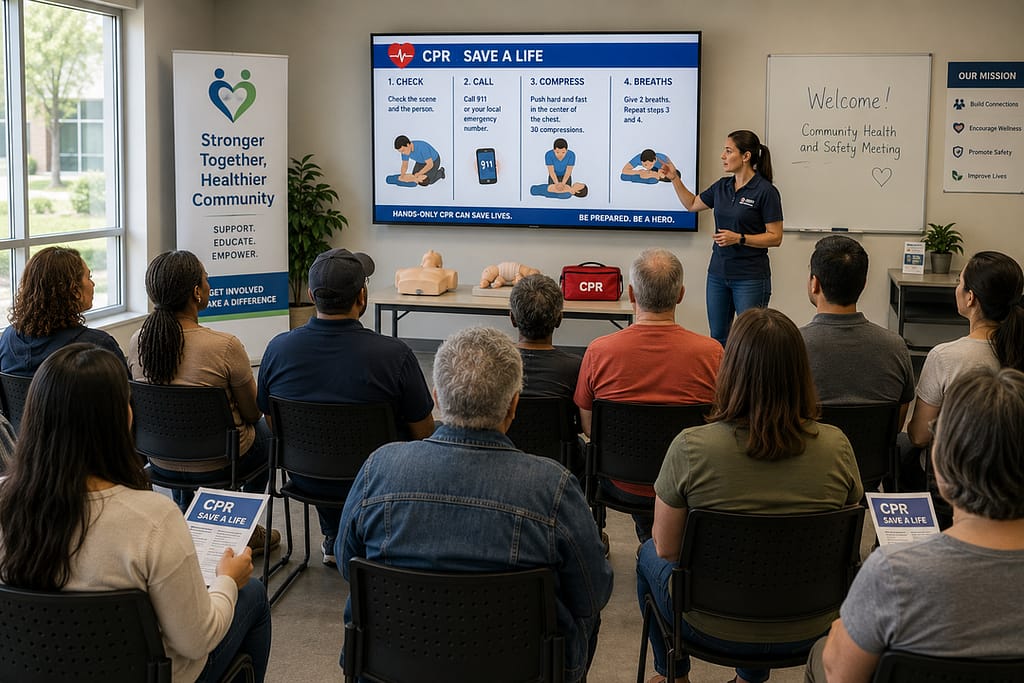
Start with a defined promise. A family event might teach adult Hands-Only CPR, basic AED operation, child and infant response, and choking relief. The family-focused course model uses separate modules and practice-while-watching instruction, offering a useful template for dividing the evening without turning it into a technical seminar.
Every attendee should press on a manikin, handle trainer AED pads, hear the device prompts, and switch roles with a partner. Avoid long lines at one demonstration station. When equipment is limited, use timed rotations and smaller registration blocks so hands-on time is protected.
Child-Focused Sessions Need More Than Smaller Manikins
Adult and pediatric response should not be presented as interchangeable. Hands-Only CPR is promoted for a teen or adult who suddenly collapses, while conventional CPR with compressions and breaths remains important for infants and children, whose cardiac arrests are often linked to breathing problems.
That makes a child-focused station essential for parents, grandparents, babysitters, coaches, and older siblings. Trainers should address age-appropriate hand placement, rescue breaths, choking, and AED pad placement using child and infant manikins. Age changes the response, and families need enough practice to feel the difference rather than merely hear about it.
Registration can ask whether participants care for infants, school-age children, or older adults. That information helps organizers assign rotations and prevents the child session from becoming an optional add-on that families miss.
Plan the Room, Registration, and Run of Show
Choose instructors before announcing the event. Verify the training organization, instructor status, equipment availability, and whether the session offers skills education, a participation record, or formal certification. Those are different outcomes and should not be blurred in promotional material.
Some attendees may need certification for employment, childcare, coaching, or regulatory purposes. A community demonstration may not satisfy that need. Organizers can compare their format with formal certification requirements and direct participants to an appropriate course when the community night is educational rather than credentialed.
Registration should collect practical information: participant age group, accessibility or language needs, certification expectations, and preferred refresher contact. Cap each session based on instructors, manikins, trainer AEDs, and room layout—not the building’s maximum occupancy. Clarity builds confidence before anyone enters the room.
A 90-minute event can work when the schedule protects practice time.
| Time | Activity | Practical Goal |
|---|---|---|
| 0–10 minutes | Welcome and emergency recognition | Identify cardiac arrest and activate help |
| 10–30 minutes | Adult CPR rotation | Practice positioning and compressions |
| 30–45 minutes | AED demonstration and partner drill | Power on, place pads, clear, and follow prompts |
| 45–65 minutes | Child and infant stations | Practice age-specific response |
| 65–80 minutes | Family scenario drill | Assign roles and combine the sequence |
| 80–90 minutes | Questions and refresher sign-up | Correct uncertainty and plan follow-up |
The scenario drill connects isolated skills to real response. Give each group a simple setting a kitchen, playground, church hall, or sports practice and ask them to act from discovery through AED use while an instructor observes.
The Weak Points That Can Undo a Strong Night
An impressive turnout can conceal a weak event. Watch for participants who never touch a manikin, AED demonstrations that stay on the instructor’s table, vague certification claims, missing child instruction, or a room so crowded that feedback disappears.
The venue is part of the lesson. Participants should leave knowing where its AED is located, whether it is accessible during normal activities, and who checks its pads, battery, cabinet, and signage. Current emergency-planning guidance also emphasizes trained responders, visible AED placement, coordination with emergency services, drills, and routine review.
Use a brief exit check rather than a satisfaction survey alone. Ask whether attendees can recognize cardiac arrest, state the first actions, locate the venue AED, and identify the right next course for their family or job. The answers reveal whether the night created readiness or only good feelings.
Make Readiness a Community Habit
A single evening can remove fear, but skills and confidence need reinforcement. Schedule a short refresher before people leave, send a simple practice reminder, and repeat the event for new parents, youth sports groups, grandparents, school staff, and neighborhood volunteers. The follow up is the program, not an administrative extra.
Community CPR and AED training matters because professional help cannot occupy the first seconds of every emergency. Families and neighbors do. The strongest event turns that reality into a rehearsed plan: recognize the collapse, call for help, begin care, use the AED, and keep going until responders arrive.