

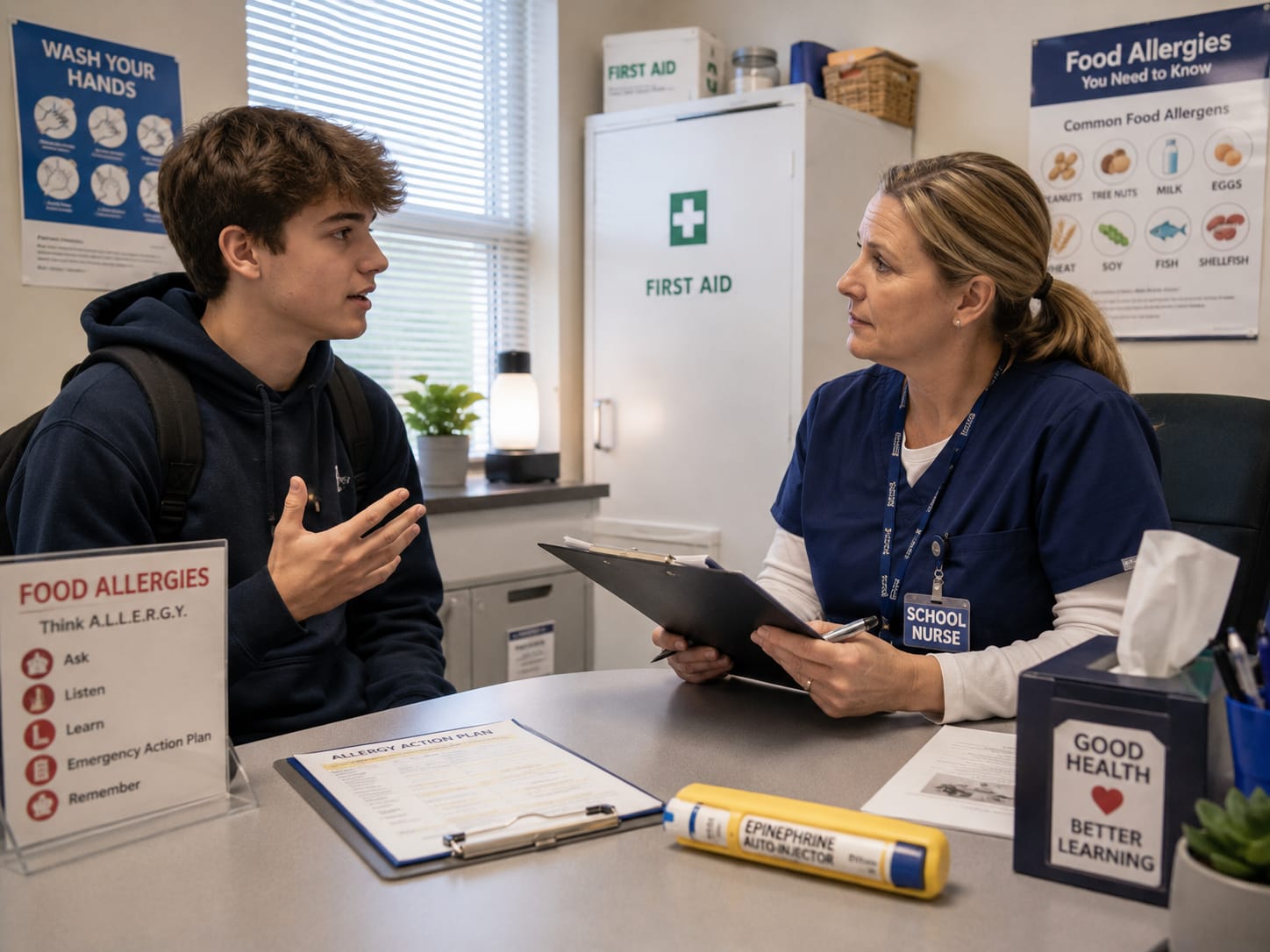
A food allergy action plan can look complete until a child leaves the usual routine. The real test comes when a substitute teacher takes over, a grandparent handles pickup, or a restaurant server hears “allergy” and assumes “preference.” With the CDC estimating that food allergies affect about 1 in 13 children, the weak point is often the handoff between adults.
The best plan is not a form filed in an office. It is a handoff system: one clear set of instructions that follows the child through school, home, activities, travel, and meals away from home. That approach runs through good family wellness guidance: make the safe response easier than improvisation.
A Food Allergy Action Plan Must Survive a Hand-Off
Families usually know the allergen, recognize familiar symptoms, and understand where medication is kept. The danger appears when that knowledge stays trapped in one person’s head.
A useful food allergy action plan should name the diagnosed allergens, describe possible symptoms, state what medication to give and when, list emergency contacts, and carry a healthcare professional’s authorization when required. It should identify whether the child can self-carry or self-administer medication, because school rules, age, and clinician guidance may affect that decision.
The plan must be readable by someone who has never met the child. “Watch closely” is not an instruction. “If these symptoms appear, follow this medication step and activate emergency help” is. The CDC’s school food allergy planning emphasizes both daily prevention and preparation for anaphylaxis.

Write for the Adult Who Has Thirty Seconds
Emergency documents often fail because they contain too much background and too little direction. A caregiver in a stressful moment needs symptom-based instructions, not a miniature medical chart.
Put the child’s name, current photograph, allergens, symptom patterns, medication directions, medication location, emergency contacts, and clinician information where they can be found immediately. Use the exact device name and dose written by the prescriber. Include special instructions if previous reactions have followed an unusual pattern.
Avoid vague food labels. “Nuts” can create confusion when the diagnosed allergy is specifically peanut, one or more tree nuts, or both. Record the clinician-confirmed wording and update it when the diagnosis changes.
The plan should also explain the child’s own language. Younger children may say their mouth feels “funny,” their tongue feels hot, or something is stuck in their throat. Adults who recognize those phrases are less likely to dismiss an early warning.
School Safety Cannot Stop at the Nurse’s Office
A school plan needs to work in the classroom, cafeteria, playground, bus line, gym, after-school club, and every school-sponsored event. Teachers, substitutes, food-service staff, coaches, trip leaders, and administrators need role-specific information.
Families should ask who keeps the plan, who can access medication, who is trained to respond, and what happens when the nurse is absent. The answers should be concrete. A locked medication cabinet is not useful if the only person with access is off campus.
Field trips deserve their own check. Confirm that the plan, emergency contacts, and medication travel together; identify the trained adult responsible; review meals and snacks; and know how emergency services will be reached. The principle is simple: medication follows the child, not the building.
School communication should also cover routine prevention. Classroom celebrations, cooking projects, shared equipment, food rewards, and unplanned treats can create exposure risks. The goal is not to isolate the student but to design participation before the invitation arrives.
Build a Portable Plan for Caregivers, Trips, and Restaurants
One master medical plan can anchor short situation-specific handoffs. The table shows what each adult needs before taking responsibility.
| Setting | Information to Share | Practical Check |
|---|---|---|
| School day | Allergens, symptoms, medication directions, contacts | Who responds if the nurse is unavailable? |
| Substitute caregiver | Warning phrases, medication location, emergency steps | Can the caregiver demonstrate the device steps? |
| Field trip or activity | Portable plan, medication, trained adult, destination details | Does the medication leave and return with the child? |
| Restaurant | Exact allergens, cross-contact concerns, safe-order decision | Has a manager or chef confirmed the request? |
| Family gathering | Unsafe dishes, serving utensils, dessert risks, emergency plan | Is one informed adult clearly responsible? |
This is not five separate medical plans. It is one clinician-guided emergency plan supported by practical instructions for each setting. The emergency care plan tools include resources for caregivers, schools, travel, and restaurants, showing how quickly the same allergy can meet different risks.
For restaurants, call ahead when possible, explain the allergy before ordering, and ask about ingredients and cross-contact practices. If the answers are uncertain or dismissive, leaving is a safety decision, not an overreaction. A chef card can support the conversation, but it cannot replace a direct exchange with the person responsible for the meal.
The Weak Signals That Expose a Fragile Plan
A plan needs attention when adults use different language for the same allergen, medication is stored without clear access, a substitute has never seen the instructions, or field-trip planning begins the morning of departure. Expired medication, an outdated photo, changed phone numbers, and unsigned forms are quieter warning signs.
Another red flag is confidence without practice. An adult may say, “I know how the injector works,” yet hesitate when asked to explain the steps. Rehearsal beats reassurance. Use the device’s trainer, review the written sequence, and ask the caregiver to repeat the response in their own words.
Children also need age-appropriate involvement. They can learn not to share food, to speak up when something feels wrong, and to identify trusted adults. That independence should add a safety layer, not shift adult responsibility onto the child.
Make the Plan a Living Routine
Review the food allergy action plan before each school year, after a reaction, when medication or dosage changes, when contact details change, and before a new caregiver or activity begins. Replace old copies rather than allowing several versions to circulate.
The strongest plan is easy to find, easy to understand, and practiced by the people expected to use it. Food allergy safety does not depend on one perfectly vigilant parent. It depends on whether every handoff preserves the same clear instructions when the routine changes and the margin for hesitation disappears.