

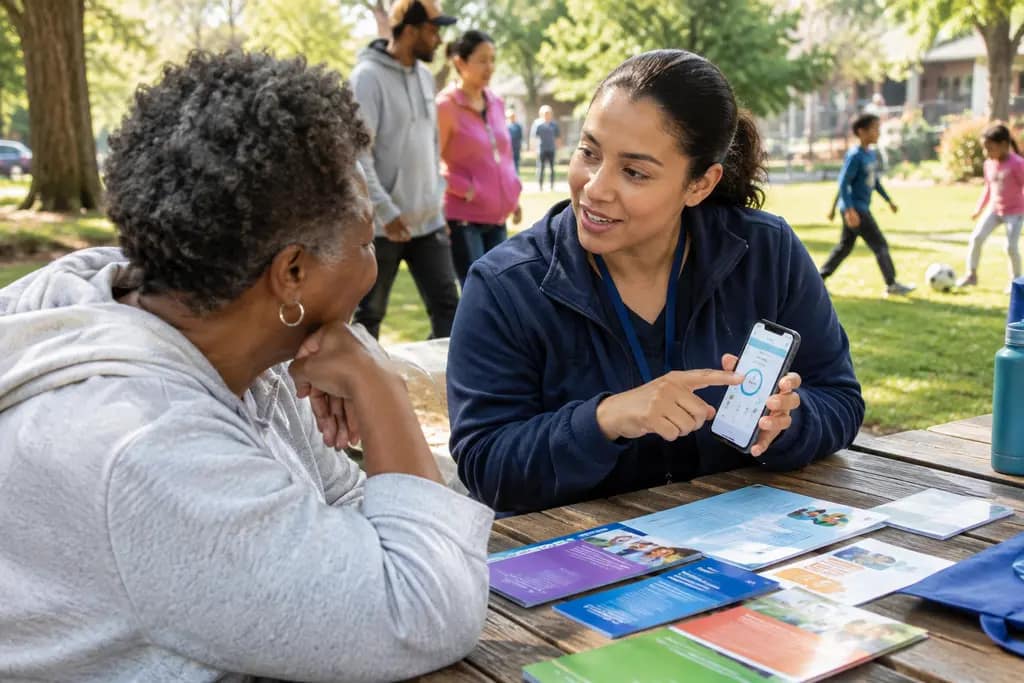
The future of health literacy is becoming less about handing people more information and more about designing health systems, community programs, and digital tools that people can realistically understand and use. SOPHE’s Strategic Plan 2026-2030, published in March 2026, points in that direction by emphasizing health education capacity, professional visibility, belonging, relationship-building, chapter partnerships, digital-first operations, and continuous quality improvement.
For community wellness leaders, that shift matters because AI-supported health tools and diagnostics are not just technical issues. They also raise practical questions: Can patients understand what a tool is saying? Can clinicians explain uncertainty clearly? Are community members involved before tools are rolled out? And are organizations checking whether language, disability access, trust, and digital barriers have been addressed?
Future Of Health Literacy In Community Engagement
Why SOPHE’s 2026-2030 Plan Matters
SOPHE’s plan, as summarized in the research notes, included Goal 1: Strengthen Health Education & Promotion Capacity. Its stated objectives included elevating the profile of health education professionals, growing a diverse and engaged community, and supporting belonging and relationship-building across partners and chapters. Those priorities suggest that health literacy work may increasingly depend on trained educators who can build trust outside clinic walls.
That is a meaningful signal for local coalitions, public health departments, libraries, faith groups, adult education programs, and patient advocacy organizations. Health literacy is often discussed as an individual skill, but community engagement asks a broader question: what conditions help people ask questions, compare options, and understand instructions without shame or confusion?
The Healthy People 2030 framework separates personal health literacy from organizational health literacy, defining the issue as both an individual ability and an organizational responsibility to make health information and services easier to find, understand, and use Healthy People 2030. That framing fits the direction of SOPHE’s plan. Teaching people matters, but so does changing forms, portals, consent language, outreach workflows, and staff communication habits.
Future Of Health Literacy Requires Shared Responsibility
The future of health literacy will likely depend on whether organizations treat communication as a quality issue rather than a brochure problem. A clinic, hospital, health plan, or public health agency can offer education sessions and still leave people behind if appointments are rushed, portal messages are hard to read, or digital tools assume high reading levels and steady internet access.
SOPHE’s operational goals, based on the research notes, also included promoting a digital-first culture, embedding continuous quality improvement, and strengthening collaboration between the national office and state or local chapters. Taken cautiously, that suggests a stronger infrastructure for community engagement: not one-time outreach, but repeated feedback, shared training, and clearer roles for chapters and partners.
Community engagement also has a time burden. People may be balancing work, caregiving, transportation, symptoms, and limited energy. A related wellness resource, Take Back Your Time, reminds us that managing time effectively can impact whether individuals can attend health classes, absorb educational materials, or pursue further inquiries.
AI Health Tools Need Community Trust
AI Literacy Is Now Part Of Health Literacy
AI-supported health tools may appear in scheduling, patient portals, triage support, imaging workflows, note summaries, risk prediction, or patient education. The research notes did not establish that any single tool is safe or unsafe for every setting, so broad claims would be inappropriate. What the evidence does support is a more careful point: AI literacy is becoming part of the health literacy conversation.
WHO’s 2026 report on responsible AI in health identified AI literacy deficits among barriers to safe and effective AI deployment, while naming codesign with patients and clinicians and participation by patients, communities, and frontline professionals as enablers WHO responsible AI report. That aligns closely with community health education practice. People need plain-language explanations of what a tool can do, what it cannot do, how uncertainty is handled, and who remains accountable for care decisions.
For diagnostics, the stakes may feel personal. A patient reading an AI-assisted summary may not know whether the wording is a confirmed finding, a probability, an administrative note, or a prompt for clinician review. A community program cannot solve all technical or regulatory issues, but it can help residents prepare better questions and recognize that automated output should not replace professional interpretation.
Community Codesign Can Reduce Misalignment
The future of health literacy should include community codesign before digital health tools are treated as ready for everyone. Codesign does not mean every person becomes a software expert. It means community members, clinicians, interpreters, disability advocates, and frontline staff can point out barriers that planners may miss.
Examples may include confusing risk scores, portal alerts that sound alarming without next steps, translation gaps, unclear consent language, or education materials that assume high digital access. In communities that have experienced poor access or discrimination, trust cannot be assumed simply because a tool is new.
HealthScope has also covered how health literacy strategies can support equity when programs use plain language, partner with trusted messengers, and train staff. That same logic applies to AI health communication: the messenger, setting, and feedback process may shape whether information is useful.
What Community Organizations Can Do Carefully
Build Education Around Questions, Not Commands
Community groups can support health literacy without giving medical advice. The safer frame is question-building. Instead of telling someone what an AI result, lab value, symptom checker, or patient portal message means for their health, a facilitator can help them ask clearer questions of a qualified clinician.
- What does this result or message mean in plain language?
- Was AI or automation involved in creating this summary or recommendation?
- What are the limits of this tool or test?
- What information from my history might affect interpretation?
- Who should I contact if the message is confusing or seems wrong?
This approach protects the boundary between education and clinical care. It also respects the reality that needs may vary by age, disability, language, pregnancy, medications, medical history, and access to follow-up care.
Measure Whether Communication Is Working
SOPHE’s emphasis on continuous quality improvement, as described in the research notes, may be especially useful for local programs. A class is not successful simply because it was offered. A portal tutorial is not equitable simply because it was posted online. Community organizations can ask whether people understood the material, felt safe asking questions, and knew what step to take next.
Simple feedback loops may include short post-session questions, teach-back practice, language access review, disability access checks, and input from community health workers. The point is not to grade patients. The point is to see whether the organization communicated clearly enough.
The research notes also described community-based and train-the-trainer efforts from 2026, including peer-led education and AI health literacy training programs aimed at underserved groups. Those examples should be interpreted cautiously because program results may depend on local staffing, trust, funding, and participant needs. Still, they suggest that peer education and community health worker models may be practical ways to bring health literacy into familiar settings.
Equity Risks In Digital Health Literacy

Disparities Should Shape Program Design
The October 13, 2026 SOPHE blog cited in the research notes described a 2025 survey of more than 2,800 U.S. adults in which more than 60% did not reach “adequate” health literacy on a brief nutrition-label assessment. The same notes reported disparities by race, ethnicity, gender, and income. Such findings should not be used to blame communities. They should raise questions about how health information is written, tested, translated, delivered, and supported.
The research notes also reported large differences in adults scoring at “basic or below basic” health literacy: about 25% of White adults, 58% of Black adults, and 66% of Hispanic adults. These numbers point toward structural barriers and uneven access to clear communication, not individual failure.
For AI and diagnostics, equity concerns may become sharper if tools require portal access, strong broadband, English-first interfaces, or confidence with charts and probabilities. If a system is built for people who already have high digital access and high health confidence, it may miss the groups that most need clear support.
Digital-First Should Not Mean Digital-Only
A digital-first strategy can help organizations update materials, track feedback, and reach people who prefer online tools. But digital-first should not become digital-only. Some people need printed materials, phone support, interpreters, in-person classes, accessible formats, or help from a trusted community health worker.
The future of health literacy will likely be judged by whether programs can keep both goals in view: better digital tools and better human support. AI may help organize information, but people still need space to ask, “What does this mean for me?” and “Who can explain this in context?”
Future Of Health Literacy In Community Practice
The most practical reading of SOPHE’s 2026-2030 direction is that health literacy is moving from a narrow education task toward a shared community and systems responsibility. The plan’s focus on professional capacity, belonging, partnerships, chapter alignment, digital culture, and quality improvement fits the needs of a health system where information is increasingly digital and, in some settings, AI-assisted.
The future of health literacy should not be framed as teaching people to accept every new tool. A safer goal is informed participation. Community members should be able to understand basic terms, question unclear outputs, recognize uncertainty, and know when a clinician or trained professional should interpret results.
For wellness groups, patient educators, libraries, and local coalitions, the next step may be modest but meaningful: build programs that invite questions, test materials with real users, include people from underserved communities, and keep education separate from diagnosis or treatment decisions. Before acting on AI-generated health information, diagnostic summaries, or portal interpretations, readers should discuss what they are seeing with a qualified healthcare professional and ask how the information applies to their specific situation.