

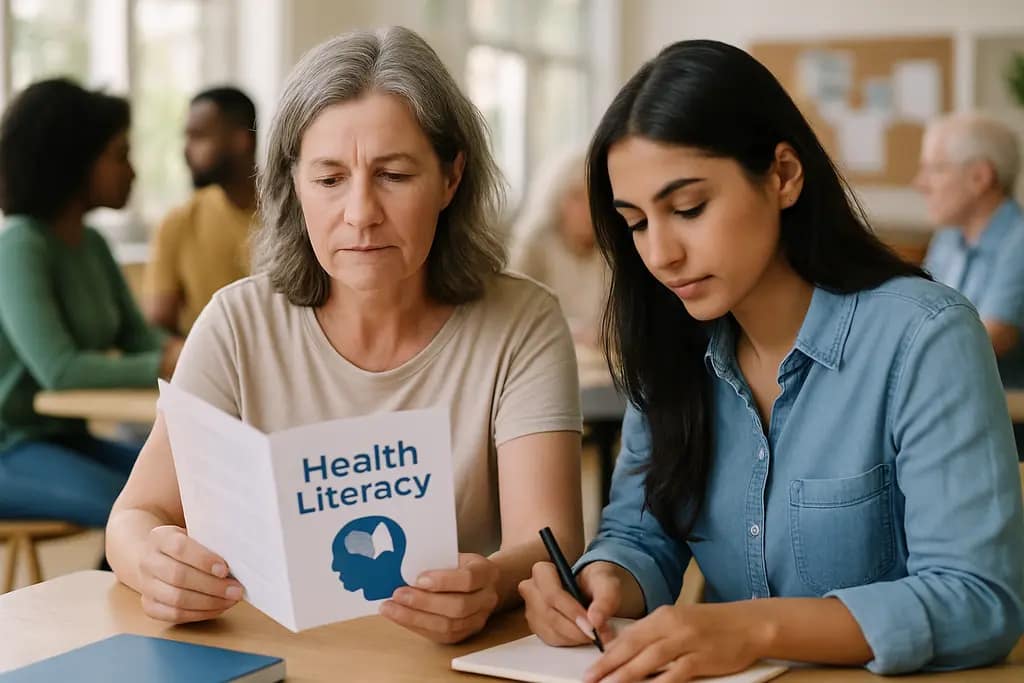
Health literacy resources can help community members connect everyday reading, math, digital skills, and health decisions in a way that feels practical rather than intimidating. For adult learners, the goal is not to become medical experts. It is to build enough confidence to read instructions, compare information, ask clearer questions, and know when a qualified professional needs to be involved.
As a community activities coordinator, I often see this link most clearly outside the clinic: at library workshops, school family nights, faith-based wellness events, insurance enrollment sessions, and support groups. People may be willing to learn, but health documents can be dense, time is limited, and a stressful appointment can make even familiar words harder to process. Adult education can give health learning a slower, more supportive setting.
Why Health Literacy Resources Belong In Adult Education
Health Literacy Resources And Plain Questions
Adult education is often framed around reading, writing, digital access, job skills, or English language learning. Those skills overlap with health tasks more often than many people realize. A person may need to read a discharge sheet, understand a food label, compare appointment instructions, fill out an insurance form, or use a patient portal. None of those tasks should be treated as a measure of personal worth; they are skills that can be practiced with the right support.
The 2003 National Assessment of Adult Literacy found that only 12% of U.S. adults had proficient health literacy, while the remaining adults had intermediate, basic, or below-basic skills according to that assessment NAAL health literacy findings. That older national result should be read carefully because tools and health systems change over time. Still, it remains a useful reminder that health information can exceed what many adults are prepared to use without support.
In community settings, a practical session might start with everyday questions: What is this form asking? Which number on the label matters for my question? What do I need to repeat back to be sure I understood? These are not treatment decisions. They are communication skills that may help a person prepare for a better conversation with a clinician, pharmacist, benefits counselor, or care team.
Education Is A Factor, Not A Label
Research suggests that education level can be associated with health literacy, but that relationship should not be used to label people. A person with formal education may still struggle during illness, stress, grief, pregnancy, caregiving, language barriers, or financial pressure. A person without a diploma may have strong practical knowledge and strong self-advocacy skills. Community programs work best when they assume mixed strengths rather than deficits.
A study published in 2025 using the All of Us Research Program cohort reported that 92.4% of participants met criteria for adequate health literacy, while inadequate health literacy was more likely among participants with less than a high school education, lower income, Black race, and male gender; the authors also noted limits in how representative the cohort was All of Us health literacy study. That finding points toward patterns, not destiny. It also suggests that adult learning programs should consider access, trust, language, income, technology, and past experiences with institutions.
What The Evidence Can And Cannot Tell Us
Measurements Do Not All Mean The Same Thing
Health literacy is measured in more than one way. Some tools focus on reading and numeracy. Others include decision-making, communication, digital skills, or confidence using health information. Because tools differ, rates can look very different across studies. A cautious reading is better than a dramatic one: many adults may benefit from clearer health communication, but no single statistic captures every community or every setting.
This matters for local planning. If a neighborhood group sees one national number and assumes the same number applies to its own members, it may miss who actually needs help. Some groups may need language support. Others may need digital coaching. Others may need help with insurance words, appointment preparation, or understanding instructions after a hospital visit. Local listening sessions, anonymous surveys, and partnerships with adult educators can help shape a program without making assumptions.
For families, health literacy often becomes shared work. A parent may read a child’s instructions. An adult child may help an older relative compare appointment notes. A spouse may sit in during a telehealth visit. HealthScope’s related discussion of health insurance literacy fits this same pattern: clear questions and trusted explanations can reduce confusion, even when they cannot remove every barrier.
Health Learning Should Stay Within Its Scope
Community educators can help people practice reading, organizing questions, and recognizing unclear information. They should not diagnose symptoms, recommend medicines, interpret test results, or tell someone to start, stop, or change treatment. That boundary protects learners and facilitators. It also keeps community education credible.
A useful rule is to separate skill practice from medical instruction. “Here is how to write down your questions before an appointment” is education. “Here is what treatment you should choose” is medical advice. “Here is how to ask what a term means” is support. “Here is what your symptom means” is outside the role of a community class.
How Community Programs Can Keep Learning Practical

Choosing Health Literacy Resources Carefully
Good health literacy resources are usually plain, specific, and transparent about their limits. They do not promise simple answers for complex conditions. They avoid shame, pressure, and sales tactics. They invite people to check information with a qualified professional, especially when the topic involves medication, surgery, pregnancy, chronic illness, supplements, or changing symptoms.
Community groups can use short activities instead of long lectures. A facilitator might ask learners to compare two appointment reminders, identify what information is missing, or practice saying, “Can you explain that another way?” Small exercises can build confidence without asking anyone to disclose private health details.
- Practice writing three questions before a medical visit.
- Use plain-language examples to compare health words and everyday words.
- Role-play how to ask for an interpreter, larger print, or written instructions.
- Review how to identify the date, dose, warning, or next step on a sample instruction sheet.
- Encourage learners to bring confusing non-urgent questions to their care team rather than relying on peers.
Programs should also be careful with condition-specific education. For instance, those curious about weight management or surgical care might find resources at a related site like Trinity Bariatric Institute, but they should always confirm personal health decisions with a clinician who is aware of their medical history, goals, and potential risks.
Support Groups Can Reinforce Skills Without Giving Medical Advice
Support groups can be a good place to practice the social side of health literacy. Members may share how they prepared for an appointment, asked for clarification, or organized paperwork. The safer groups avoid turning one person’s experience into a recommendation for everyone else.
A facilitator can say, “Please share what helped you ask questions, but do not tell another member what treatment to choose.” That simple boundary makes room for lived experience while keeping medical decisions in the right setting. It also reduces the risk that confidence, urgency, or frustration will turn into unsupported advice.
Health Literacy Resources In Community Practice
Health literacy resources are most useful when they are built into ordinary community life. A class at an adult learning center, a library session on patient portals, or a wellness table at a neighborhood event can make health information feel less isolated. The tone matters: people are more likely to participate when programs are respectful, practical, and clear that needing help with health information is common.
For community members, a reasonable next step is to ask: What health words confuse me most? What forms or instructions are hardest to use? Do I need help with reading, numbers, language access, internet access, or confidence asking questions? Those answers can guide which local class, support group, benefits counselor, or health educator may be useful.
For any personal health concern, the safest follow-up is a conversation with a clinician or qualified care team member. Ask what the information means for your situation, what options exist, what risks or tradeoffs should be considered, and what signs would require prompt medical attention. Community learning can prepare the questions; clinical care should handle the medical answers.