

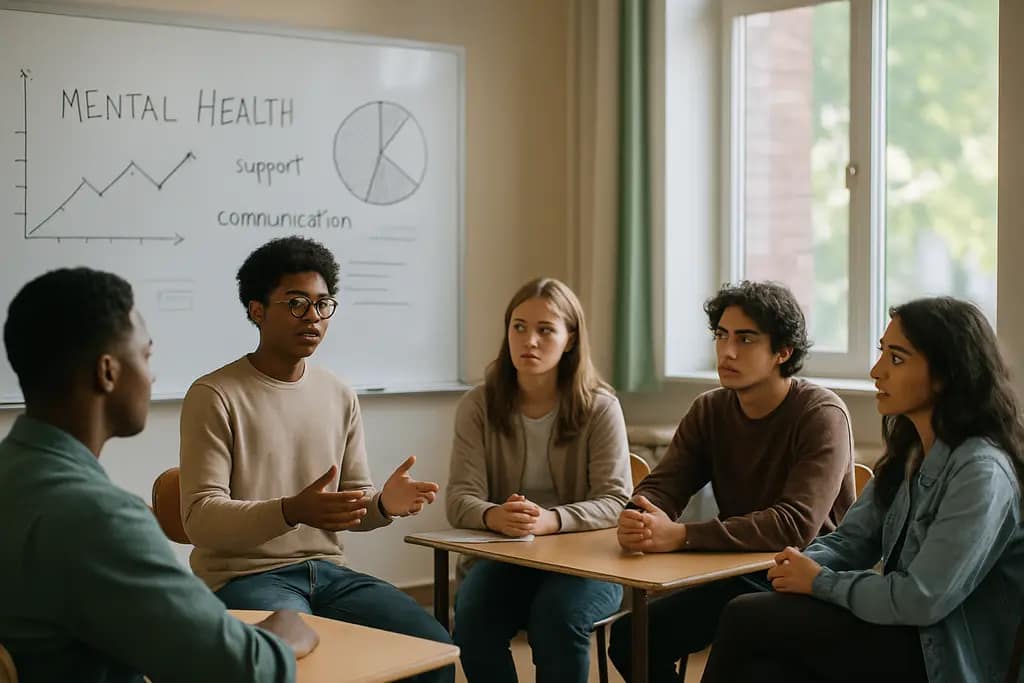
United for Youth offers a useful case study in how a county, school system, community partners, caregivers, and young people can organize around student behavioral health without treating schools as stand-alone clinics. For families, the most useful lesson may be the structure: prevention, early identification, access to services, workforce planning, and funding alignment all have to be discussed together, while medical decisions remain with qualified professionals.
Why Student Behavioral Health Needs A School Lens
National Data Gives Local Work Context
Student behavioral health concerns are not limited to one district or one state. In 2023, about 20.3% of U.S. adolescents ages 12–17 had a current diagnosed mental or behavioral health condition, including anxiety, depression, or behavior and conduct problems, according to a National Survey of Children’s Health data brief available through NCBI Bookshelf. That figure was described as higher than the 2016 estimate of about 15.0%, which suggests that schools and families are facing needs that have grown over time.
High school data also point to significant distress. The 2023 Youth Risk Behavior Survey reported that 39.7% of U.S. high school students had persistent feelings of sadness or hopelessness during the past year, 28.5% reported poor mental health during the past 30 days, 20.4% seriously considered attempting suicide, and 9.5% attempted suicide, according to the CDC’s YRBS report. These numbers should be handled with care: they describe populations, not any single student’s experience.
For a parent or caregiver, school-based behavioral health work can feel hard to interpret. A wellness lesson, a referral process, a peer event, and a county-funded service may all sit under one broad program name, yet each has a different purpose. That is why the school lens matters. Schools are places where students spend time, build relationships, show changes in behavior, and encounter adults who may notice concerns early. They are not a replacement for clinical care, but they can be part of a wider support network.
How United for Youth Frames Student Behavioral Health
United for Youth Priorities For School Communities
United for Youth was launched in 2023 by the Coalition for Safe Schools and Communities in San Mateo County, California, with input from more than 20 public agencies, community-based organizations, youth, and caregivers. In September 2024, the Vision 2030 Plan of Action was released to guide youth behavioral health priorities and strategies over a six-year period. That timing matters because it placed the effort beyond a single awareness campaign and into a longer implementation plan.
The Vision 2030 work identifies five major priorities. These priorities are broad, and families should not read them as promises that every school will offer the same services at the same pace. They are better understood as planning categories that can help communities ask clearer questions.
- Expand prevention and education efforts for social-emotional well-being.
- Improve early identification of behavioral health needs and access to services.
- Support greater access to youth-centered treatment services.
- Invest in behavioral health workforce diversity and sustainability.
- Coordinate public/private funding and technology resources.
For families, United for Youth can be read as an attempt to connect prevention, referral, and service capacity rather than leaving each school or caregiver to solve the problem alone. That does not mean a program can diagnose a child, replace a therapist, or guarantee access to care. It may, however, create clearer pathways for education, screening conversations, referrals, and community support when concerns arise.
Funding Signals A Longer Planning Horizon
Measure K funding of $1.5 million over 28 months was approved to support Vision 2030 implementation through a Memorandum of Understanding between San Mateo County Behavioral Health and Recovery Services and the San Mateo County Office of Education. The funding period runs from February 25, 2025, through June 30, 2027. As of September 3, 2026, that period had not ended, so the fairest interpretation is that implementation was still within its approved funding window.
Measure K grants awarded in August 2025 to four grantees supported direct programming. Quarterly reporting later described 113 events and 6,624 students reached through direct services and support during a recent reporting period. Those figures are useful, but they should not be stretched beyond what they show. Reach and event counts can indicate activity and access points; they do not, by themselves, prove clinical improvement or long-term outcomes.
What Schools And Families Can Watch In Implementation
Equity Goals Need Clear Measurement
One stated aim under the Measure K agreement is to increase the percentage of youth served from special populations, including race and ethnicity groups and LGBTQIA+ or SOGI populations, by 10% over the term of the agreement. The baseline was described as zero, with measurement planned every six months. That structure gives the program a way to track whether access is expanding beyond general participation numbers.
Equity measurement can be helpful, but families and schools should interpret it cautiously. A higher percentage served may reflect better outreach, better data collection, stronger trust, or changes in program design. It may also raise questions about privacy, consent, cultural fit, and whether students feel safe using services. Good implementation should make room for all of those questions without assuming that one metric tells the whole story.
Peer Leadership Should Stay Within Safe Boundaries
Youth voice is one of the more promising parts of school wellness work, especially when students help shape events, language, and outreach. A related HealthScope discussion of teen wellness councils makes a similar point: youth-led efforts can support participation, but they still need adult guidance, clear roles, and safety procedures.
That boundary is especially relevant for behavioral health. Students can help reduce stigma, share resource information, identify barriers, and design activities that feel more approachable. They should not be expected to counsel peers, assess risk, or manage serious disclosures without trained adults. If a student expresses immediate safety concerns or talks about self-harm, families and school staff should seek professional or emergency support rather than relying on peer support alone.
Family wellness also depends on health literacy across many parts of care. For families seeking comprehensive support and learning how educational initiatives can bolster health decisions, a relevant network resource on bariatric education might offer valuable insights to consider alongside behavioral health strategies. Behavioral health concerns for children and adolescents should still be discussed with pediatric, mental health, or school-based professionals who know the student’s situation.
United for Youth And Family Wellness Basics
A careful reading of United for Youth suggests several practical questions for caregivers, school leaders, and community partners. What prevention lessons are students receiving? How are concerns identified without labeling students unfairly? Who explains referral options to families? How is privacy protected? How are youth from groups with documented disparities being reached? What support exists for teachers and staff who are often asked to notice concerns before a crisis develops?
These questions matter because school behavioral health programs can drift in two directions. One risk is becoming too vague, where wellness language is positive but families cannot tell what help is available. The other risk is becoming too clinical for the school setting, where staff or peers are informally asked to carry responsibilities that belong with trained professionals. A stronger model keeps education, connection, referral, and treatment roles distinct.
Families do not need to wait for a crisis to ask about school supports. They can ask how to contact counseling staff, what happens after a concern is raised, how caregivers are included, and what community referrals may be available. If a student already has a clinician, families can ask how school supports might coordinate with that care while respecting privacy rules and the student’s developmental needs.
For any child or teen showing changes in mood, behavior, sleep, school engagement, social connection, or safety, the next step should be a conversation with a qualified clinician, school mental health professional, or pediatric care team. Helpful questions include: What signs should we monitor? What school supports are appropriate? When is a referral needed? How should the family respond if safety concerns appear? Community initiatives can open doors, but individualized care decisions belong in a professional relationship.